Developing and evaluating new technologies. Priorities for these tools have so far been set by the literature and by regulators. This programme asks the people who will use them, build them, buy them, regulate them and receive them.
Each stage is reported as a piece of work in its own right and stands on its own. Together they are a first attempt at a structured, evidence-based account of AI in SEM and its adjacent fields: what the literature actually shows, what the people affected by these tools think should happen, and where they agree.
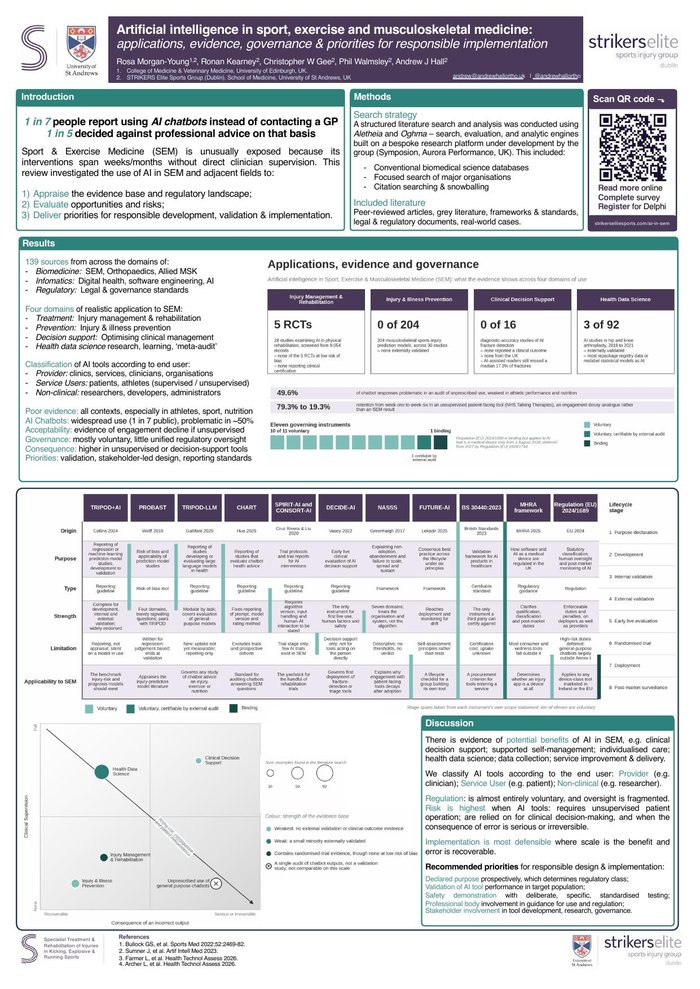
A structured search and appraisal across 139 sources spanning biomedical, informatics and regulatory literature, mapping what is claimed for AI in SEM, what has actually been evaluated, and how these tools are governed across their lifecycle.
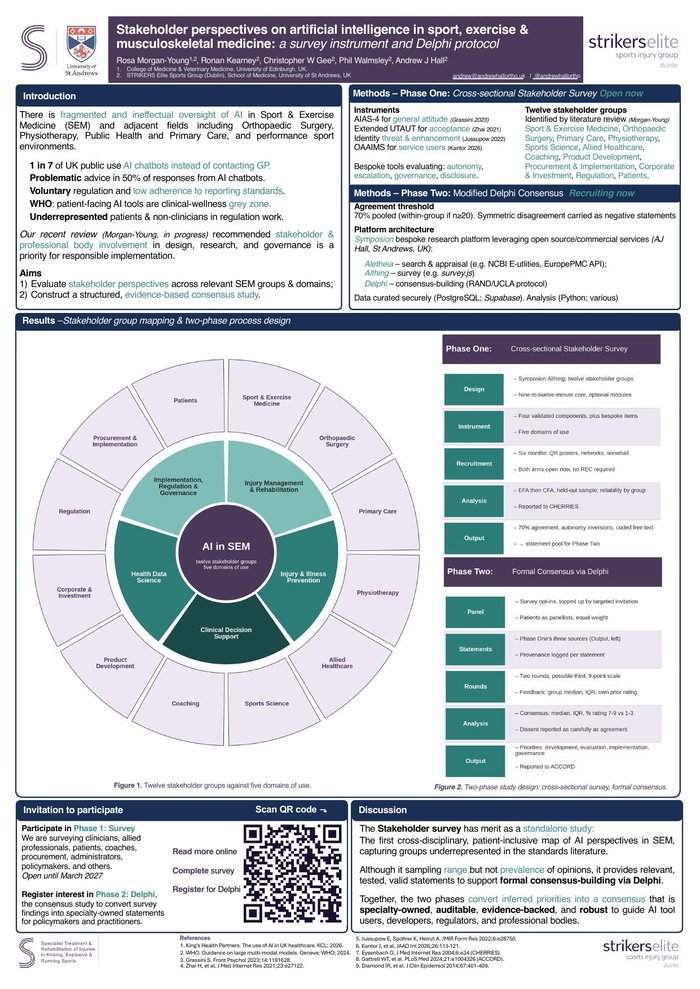
A cross-sectional survey of twelve stakeholder groups, testing what the review found against the people who use, build, buy, regulate and receive these tools. Closes 11 March 2027.
A formal consensus study that tests statements drawn from the survey against a panel over successive rounds, until the panel agrees or its disagreement is itself recorded. Register your interest when you take the survey.
The full detail behind each stage, as presented to the Faculty of Sport & Exercise Medicine.
Artificial intelligence is arriving in sport, exercise and musculoskeletal medicine faster than the evidence describing it, and considerably faster than the arrangements meant to govern it. This programme maps what these tools actually do across the specialty, what governs them and with what force, and what the people who will use and receive them think should happen.
A scoping review, registered prospectively and reported to PRISMA-ScR, mapping what is claimed, what has been evaluated, and in which populations. Written so that one branch can later become a systematic review reusing the same search and screening ledger.
Not simply which guidance exists, but what each instrument actually compels, at which point in a tool's life, and who is answerable when it fails. Guidance without force is a different object from regulation, and the distinction is rarely drawn.
People are already consulting general-purpose tools about their injuries, outside any clinical pathway and outside every governance instrument written for medical devices. This strand measures that, rather than assuming it.
The survey below, followed by a formal consensus process that takes the statements it generates and tests them. The point is to set priorities with the people affected rather than for them.
A modified RAND/UCLA Delphi, run once the survey's statement pool is complete. Statements come from three sources: items reaching 70% agreement in the pooled sample or within any single group of twenty or more, inverted-choice answers on tool autonomy, and free-text comments independently coded and verified. Each statement's provenance is logged and carries through every round.
The programme works to five domains throughout. They are used consistently across the review, the survey and every output, so that a finding in one can be placed against a finding in another.
Tools that guide a person through a rehabilitation programme between appointments: progressing exercises, giving feedback on movement, prompting adherence.
Tools that improve health before or instead of an intervention, including preparation while waiting for surgery.
Tools offering a clinician a diagnosis, a prognosis, a risk estimate or a treatment recommendation.
Using data generated in ordinary care to audit services, learn what works, and build and improve tools.
The arrangements by which these tools are approved, monitored and held to account, including who checks that a tool still works after it has been adopted.
Most work in this area asks clinicians. This programme asks everyone with a stake in whether these tools are adopted, including the people they are used on. Questions adapt to the respondent's role, so a regulator and a patient are asked the same underlying question in terms that make sense to each.
The core takes nine to twelve minutes, with optional sections afterwards, and you can stop at any point: each section you finish is kept. No name, workplace or email address is stored with your answers.

What we hold. We do not ask for your name, your workplace or your email address, and none is stored with your answers. Responses are held in an access-controlled database hosted in the United Kingdom and are reported only in aggregate, or as short anonymous quotations carrying nothing capable of identifying you.
Free text. We ask you not to name people, hospitals, employers or patients. Every free-text answer is screened automatically for personal information before any member of the research team reads or quotes it, and is not used until it has passed that screen.
Network addresses. Our hosting provider records the network address of visiting devices as part of running the service, as any website does. Those records sit outside the survey database, are never joined to your answers, and are not available to the research team for analysis. We state this rather than claim that nothing whatever is recorded.
If you register for the second phase. Your email address is written to a separate table with no link of any kind to your answers: no shared identifier, and only the date rather than the time of day, so the two cannot be matched by when they arrived. You can ask us to remove it at any point.
Standards. Information is handled in accordance with the UK General Data Protection Regulation and the Data Protection Act 2018, and we apply the Caldicott principles to any information capable of identifying an individual. The University of St Andrews is the data controller.
Governance status. This study has been assessed using the NHS Health Research Authority decision tools and does not require NHS Research Ethics Committee review. Written confirmation is held with the study documents and is available on request.
Questions, or a request to withdraw your registration: ajh52@st-andrews.ac.uk.